
Welcome
By selecting the Yes, leave Opcaseportalsg.com option you understand that you are leaving the website and that you will be redirected to another Internet site belonging to third parties, for whose content or opinions Amgen Singapore is not responsible and makes no representations regarding such content or its accuracy. By selecting this option and accessing linked third-party sites, you understand that you do so at your own risk.
The website to which you will be redirected may be designed exclusively for residents of a particular country or countries, as advertised on that website. As a consequence, the website to which you will be directed may contain information on pharmaceutical products or indications that are not approved in Singapore. If you reside in a country other than the one to which such website is directed, please contact your local Amgen affiliate for the correct information on products in your country of residence.


Case contributed by Dr Gamaliel Tan Yu-Heng, Orthopaedic Spine Surgeon, Mount Elizabeth Hospital, Singapore.
Patient Information
Age: 84 years
Sex: Female
Underlying diseases:
- Dementia
-
History
Presenting complaint
- Right knee pain after a fall at home
- Duration: 1 day
- Patient uses walking frame at home, assisted by helper.
- Patient fell in toilet and hit her right knee.
Other relevant history
- Patient underwent a left total hip replacement in 2011
- Right knee pain after a fall at home
-
Physical examination
- Physical examination revealed right knee hemarthrosis
-
Investigation
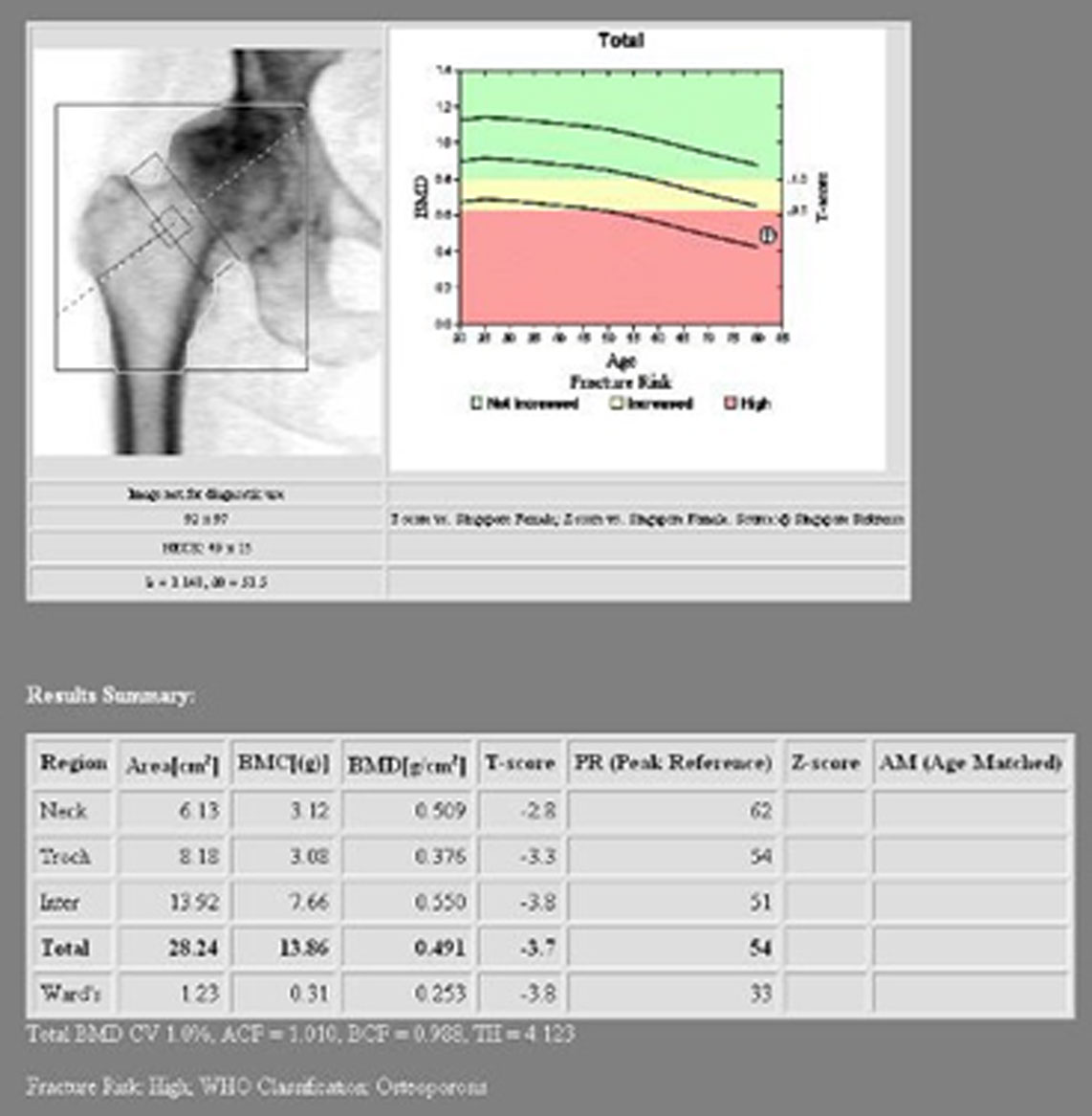
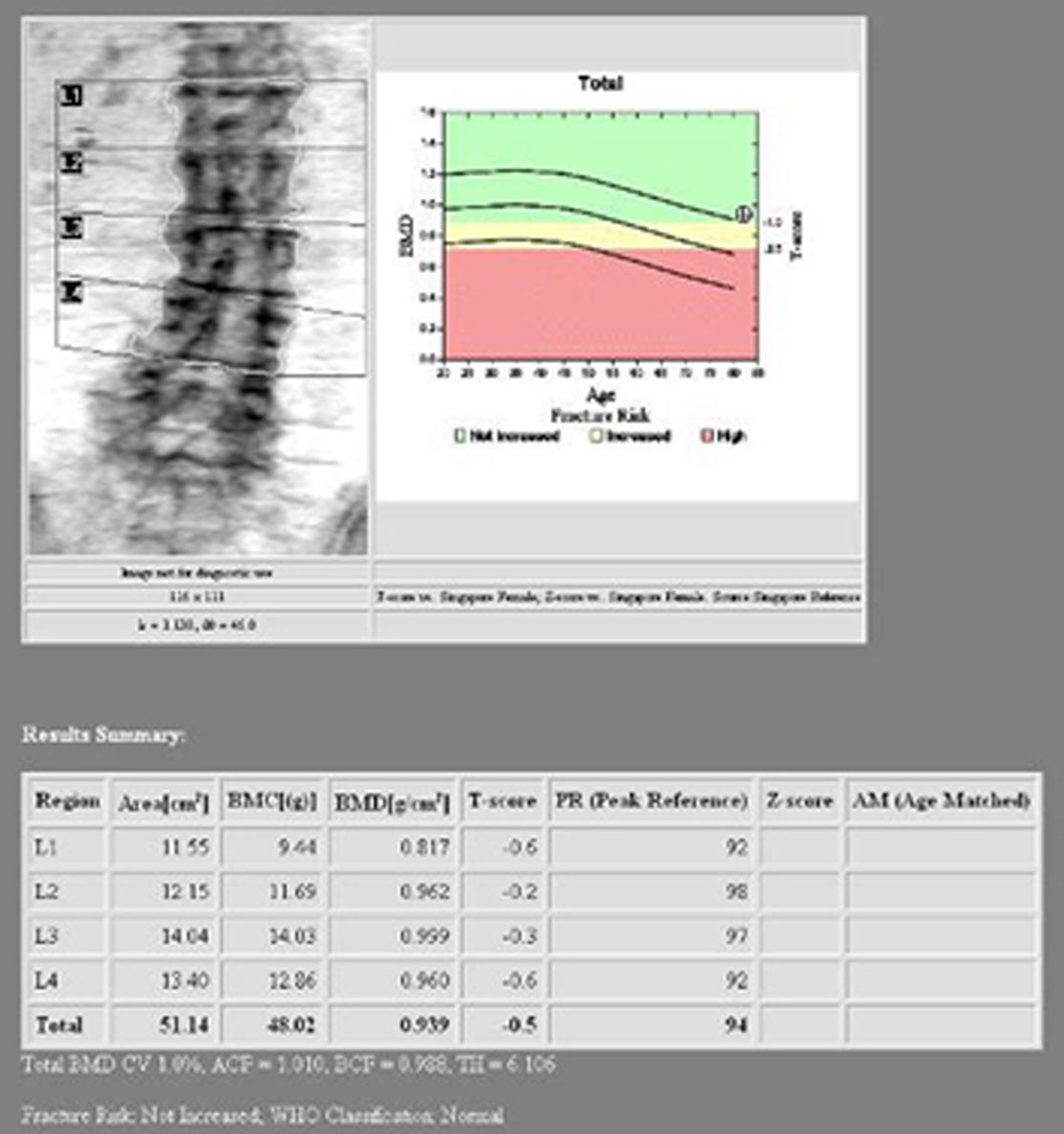
BMD on December 2023
- Hip T-score: -3.7
- Spine T-score: -0.5
Right Hip BMD Before Romosozumab Initiation
Region BMD
(g/cm3)T-score Right Neck 0.509 - 2.8 Total 0.491 - 3.7 Spine BMD Before Romosozumab Initiation
Region BMD
(g/cm3)T-score L1 0.817 - 0.6 L2 0.962 - 0.2 L3 0.999 - 0.3 L4 0.960 - 0.6 Total 0.939 - 0.5 -
Treatment
Non-pharmacological
- Calcium
- Vitamin D
Pharmacological
- Romosozumab was initiated for 12 months, until January 2025
- Patient is at a high risk of falls given her dementia and frailty. Romosozumab was chosen as it provides the fastest way to improve her bone density.
- Patient was maintained on denosumab.
-
Follow-up
Disease progression
- There is a sustained improvement of BMD scores after romosozumab initiation and denosumab initiation.
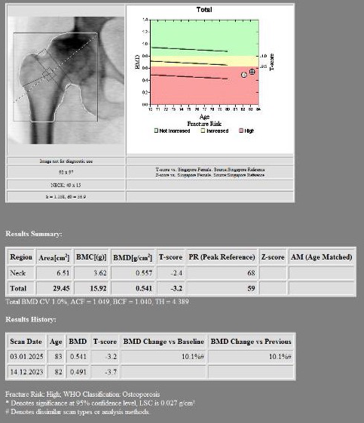
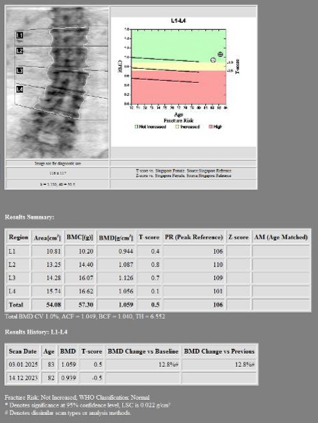
- BMD on January 2025, 1 year after romosozumab initiation:
- Hip T-score: -3.2
- Spine T-score: +0.5
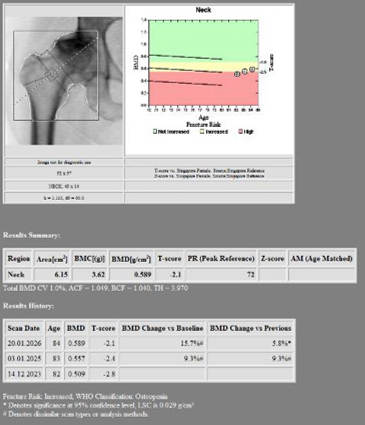
Right Hip BMD After Romosozumab Initiation
Region BMD
(g/cm3)T-score Right Neck 0.557 - 2.4 Total 0.541 - 3.2 Spine BMD After Romosozumab Initiation
Region BMD
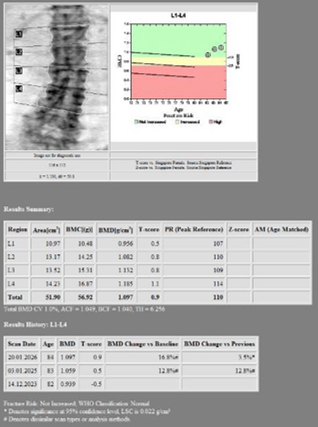
(g/cm3)T-score L1 0.944 0.4 L2 1.087 0.8 L3 1.126 0.7 L4 1.056 0.1 Total 1.059 0.5 - BMD on January 2026, 1 year after denosumab initiation:
- Hip T-score: -2.1
- Spine T-score: +0.9
Right Hip BMD After Denosumab Initiation
Region BMD
(g/cm3)T-score Right Neck 0.589 - 2.1 Spine BMD After Denosumab Initiation
Region BMD
(g/cm3)T-score L1 0.956 0.5 L2 1.082 0.8 L3 1.132 0.8 L4 1.185 1.1 Total 1.097 0.9 -
Summary
- Patient complained of right knee pain after a fall at home, and was found to have right knee haemarthrosis
- The BMD values on presentation were:
- Hip T-score: -3.7
- Spine T-score: -0.5
- Patient is at a high risk of falls given her dementia and frailty. Romosozumab was initiated for 1 year as it provides the fastest way to improve her bone density.
- After 1 year on romosozumab, there was an improvement in her BMD scores.
- Hip T-score: -3.2
- Spine T-score: +0.5
- After 1 year on denosumab, there was a sustained improvement in her BMD scores.
- Hip T-score: -2.1
- Spine T-score: +0.9
- Patient was maintained on denosumab.
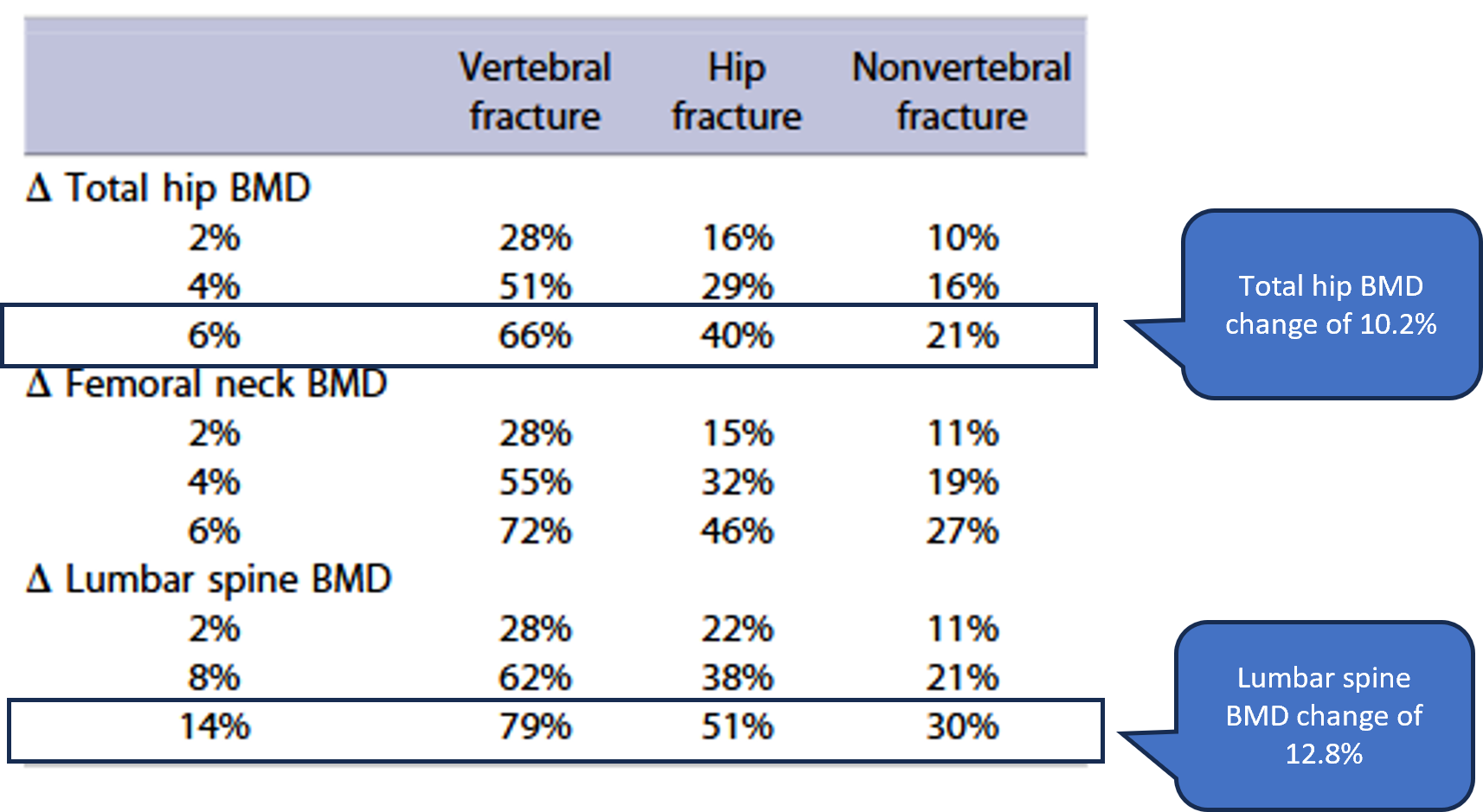
- Changes in BMD after completing 1 year of Romosozumab
- Total hip BMD changes: [(0.541 – 0.491)/0.491 X 100% = 10.2%
- Lumbar spine BMD changes: [(1.059 – 0.939)/0.939 X 100% = 12.8%
-
Estimated Fracture Risk Reduction Associated with BMD Improvement
Estimated Fracture Risk Reduction1
-
References
1. Bouxsein ML, Eastell R, Lui LY, et al; FNIH Bone Quality Project. Change in Bone Density and Reduction in Fracture Risk: A Meta-Regression of Published Trials. J Bone Miner Res. 2019 Apr;34(4):632-642.
Abbreviations
BMD, bone mineral density

-
Important Safety Information:Osteoporosis Case BinderThis curated collection of patient case studies aims to provide healthcare practitioners in the area of bone health, with a comprehensive understanding of risk-based treatment approach in the long-term management of patients living with osteoporosis.The patient cases were contributed by bone health experts from respective clinical setting, incorporating evidence-based discussions, guidelines and clinical considerations in the individualised treatment sequencing plans of different real-world scenarios..Please review full product information before prescribingFor Healthcare Professionals Only.Please refer to full prescribing information prior to administrationFor information on Amgen products or to report an adverse event involving an Amgen product, please contact Medical Information at 800-616-7094 or medinfo.JAPAC@amgen.comSC-SGP-AMG785-00048-May2026